Systellar · Deep-tech B2B · Lectura de 9 min
synapse™, plataforma de ingeniería de satélites · Systellar
0 → 1 en 10 semanas · Un año después, un equipo real trabaja su nave en synapse™
Caso de estudio de Vicente Molero, Senior Product Designer.
Resumen
Systellar · Deep-tech B2B
De hipótesis a plataforma aeroespacial
Cuando la solución de partida no es la que hace falta
Systellar, una startup deep-tech de Barcelona, quería construir synapse™: una plataforma para diseñar satélites. Los founders llegaron con una idea clara: un chat de IA como puerta de entrada al producto. Sesión a sesión, entendiendo el dominio con ellos y con el feedback de ingenieros externos, llegamos a otra solución: un modelo vivo del satélite donde el ingeniero hace MBSE sin saber que lo hace, y donde los agentes de IA trabajan con las mismas reglas que una persona.
- Rol
- Senior Product Designer · freelance · único diseñador
- Cliente
- Systellar Space
- Fechas
- Verano de 2025 · 10 semanas
- Equipo
- 2 cofundadores: CEO (especialista MBSE) y CTO (operaciones de satélites) · equipo de desarrollo pequeño
- Alcance
- Arquitectura, Requisitos, Verificación, Workflows, Control de versiones y la experiencia del agente de IA
- Contexto
- Startup deep-tech de Barcelona, hoy acelerada por Techstars. Cuando entré no había producto, solo una base técnica y una idea de solución: un chat de IA.
En 30 segundos
Resumen en 30 segundos
- Problema
- En un satélite, un cambio en un componente afecta a masa, energía y térmico. Pero cada dato vive en una hoja de cálculo, un script o un PDF distinto, y los desfases se descubren tarde, en integración o en ensayos.
- Solución
- La idea inicial era un chat de IA. Tras entender cómo trabajan los ingenieros, la cambiamos por una plataforma donde todo el satélite es un único modelo vivo. Los ingenieros trabajan con componentes y conexiones físicas, no con sintaxis. Cada cambio muestra su impacto antes de aplicarse, y los agentes de IA pasan por la misma revisión que una persona.
- Impacto
- De la pizarra a producto en 10 semanas. Un año después, Tumbleweed trabaja su nave Oasis en synapse™, y su CTO destaca que es más fácil de entender que el software de ingeniería habitual.
Impacto
- 10 semanas — De cero producto a una plataforma demostrable con clientes e inversores, con cinco módulos diseñados.
- 1 cambio de rumbo — Del chat de IA como centro del producto a un modelo vivo del sistema con la IA trabajando dentro.
Qué pasó después
Mi encargo terminó con esas 10 semanas, con todos los entregables cerrados. Lo que vino después es recorrido del producto, no resultado mío, pero confirma la dirección:
- Systellar entra en Techstars London.
- Finalista del EU Startup Summit, entre 15 elegidos de más de 1.600 candidaturas.
- Tumbleweed elige synapse™ y trabaja su nave Oasis en él. Su CTO destaca que es más fácil de entender que la mayoría del software de ingeniería.
Los hitos de la empresa (Techstars, EU Startup Summit) son contexto. El impacto atribuible al diseño es el tiempo a producto y la adopción por un equipo de ingeniería real.
El problema
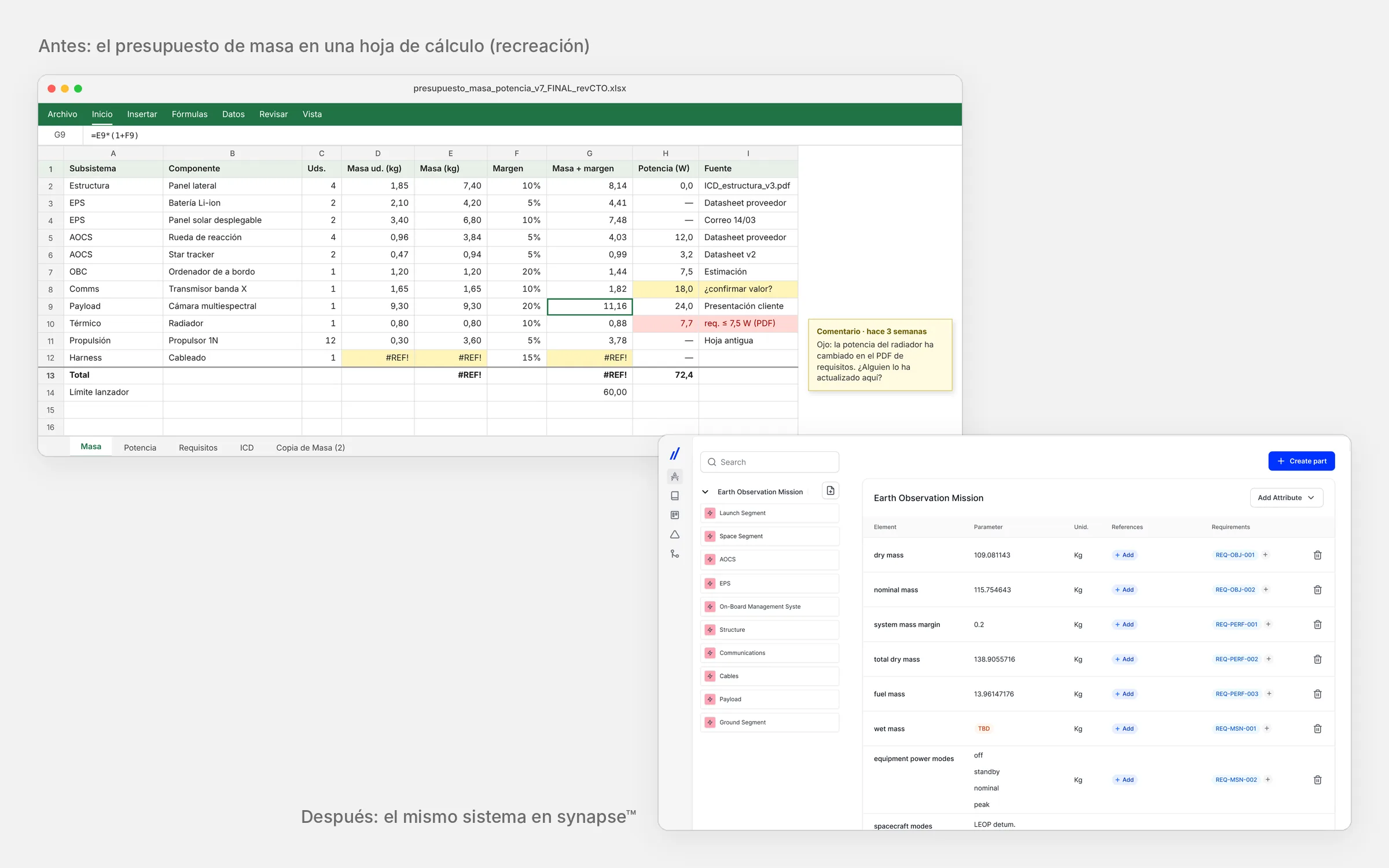
Los satélites no se complican por falta de cálculo, sino porque las disciplinas pierden la sincronización. El presupuesto de masa vive en una hoja de cálculo, los requisitos en un PDF que nadie reabre tras la firma y las interfaces en presentaciones. Cuando cambia un valor, nada avisa de qué depende de él.
La respuesta de la industria existe: el MBSE con SysML v2, un modelo del sistema legible por máquinas. Pero las herramientas tradicionales exigen semanas de formación antes de modelar el primer subsistema, así que los equipos pequeños y rápidos no lo adoptan. El problema no era técnico. Era de adopción.
Discovery
No venía del sector aeroespacial, y el punto de partida ya estaba decidido: un chat de IA. Antes de diseñarlo, necesitaba entender qué hacen estos ingenieros cada día y por qué sus herramientas actuales (CATIA, Cameo, Excel) no resolvían la coordinación. Los founders habían construido modelos de sistema en Airbus y la ESA y operado 8 satélites, así que fueron mi primera fuente de dominio.
- Sesiones cada 2–3 semanas con los dos founders: primero revisábamos avances y conclusiones, y después bocetábamos juntos cómo veían ellos cada parte del satélite.
- Feedback de ingenieros externos, que los founders recogían y traían a cada revisión.
- Entre sesiones, trabajo con los materiales reales que me compartían: hojas de masa, interfaces y matrices de requisitos.
Partimos de cuatro protopersonas que definimos con los founders: un comercial técnico, una ingeniera de sistemas junior, un ingeniero jefe de integración y una responsable de normativa. Eran hipótesis, no research, pero sus frustraciones coincidían: información dispersa, desactualizada y sin saber cuál es la buena. Y con la IA había un patrón claro: la usarían si les ahorra trabajo, pero solo si respeta sus estándares y su trabajo se puede revisar.
- «Si no encuentro rápido la información correcta, pierdo una oportunidad de negocio.»
- «Si tuviera ejemplos claros de documentos anteriores, aprendería mucho más rápido.»
- «No tengo tiempo para revisar cada detalle, necesito que la documentación sea clara desde el inicio.»
- «Sin una documentación clara y precisa, el proyecto no pasa la revisión.»
Protopersonas iniciales. Hipótesis de partida, no resultado de research.
- El momento clave fue intentar trazar cómo se usaría el chat en un flujo de trabajo real. El chat respondía preguntas, pero el trabajo seguía viviendo en hojas de cálculo y documentos. Cuanto más mirábamos cómo trabaja un ingeniero, menos sentido tenía.
- Los ingenieros piensan en componentes y cables, no en bloques y relaciones del estándar. La sintaxis de SysML v2 era una barrera, no una ayuda.
- Lo que necesitaban primero no era dibujar el sistema, sino saber qué se rompe cuando algo cambia.
- Un agente de IA solo genera confianza si su trabajo se puede revisar igual que el de un compañero.
Decisiones
Tres momentos en los que la decisión correcta no era la obvia.
Del chat al modelo: cuestionar la solución de partida
Los founders llegaron con un chat de IA como corazón del producto. Tenía sentido en una demo y es lo que el mercado espera ver. No diseñé pantallas del chat: empecé por wireframes para entender la arquitectura del producto, pensando siempre en cómo trabaja un ingeniero. Y ahí el chat se quedaba fuera del flujo: respondía preguntas mientras el trabajo seguía en hojas de cálculo y documentos.
El cambio no fue de un día para otro. El chat fue perdiendo peso sesión a sesión, hasta una reunión con los founders en la que quedó claro para todos que no era el centro del producto. No hizo falta ganar una discusión: bastó con poner la forma de trabajar del ingeniero delante de la idea.
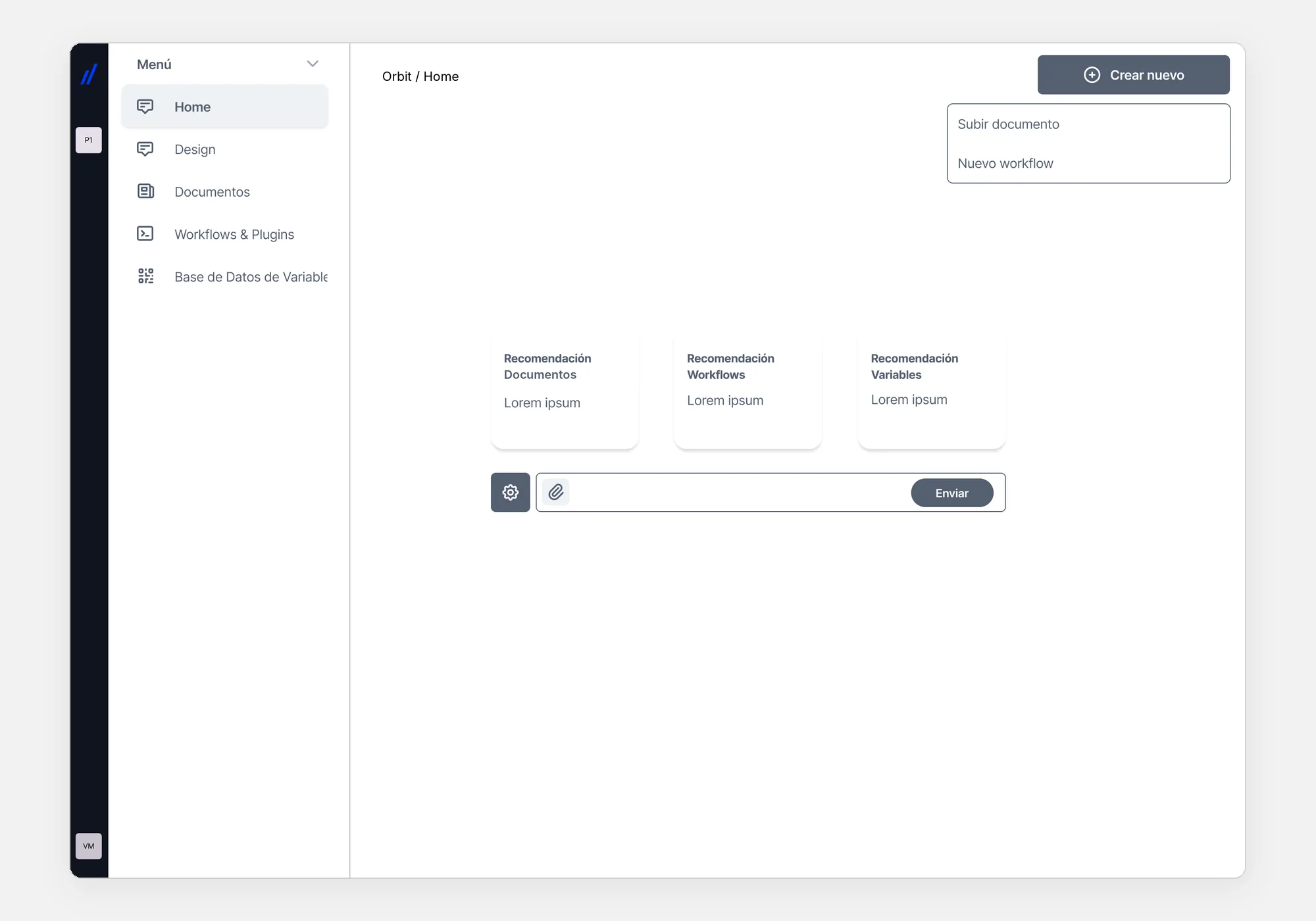
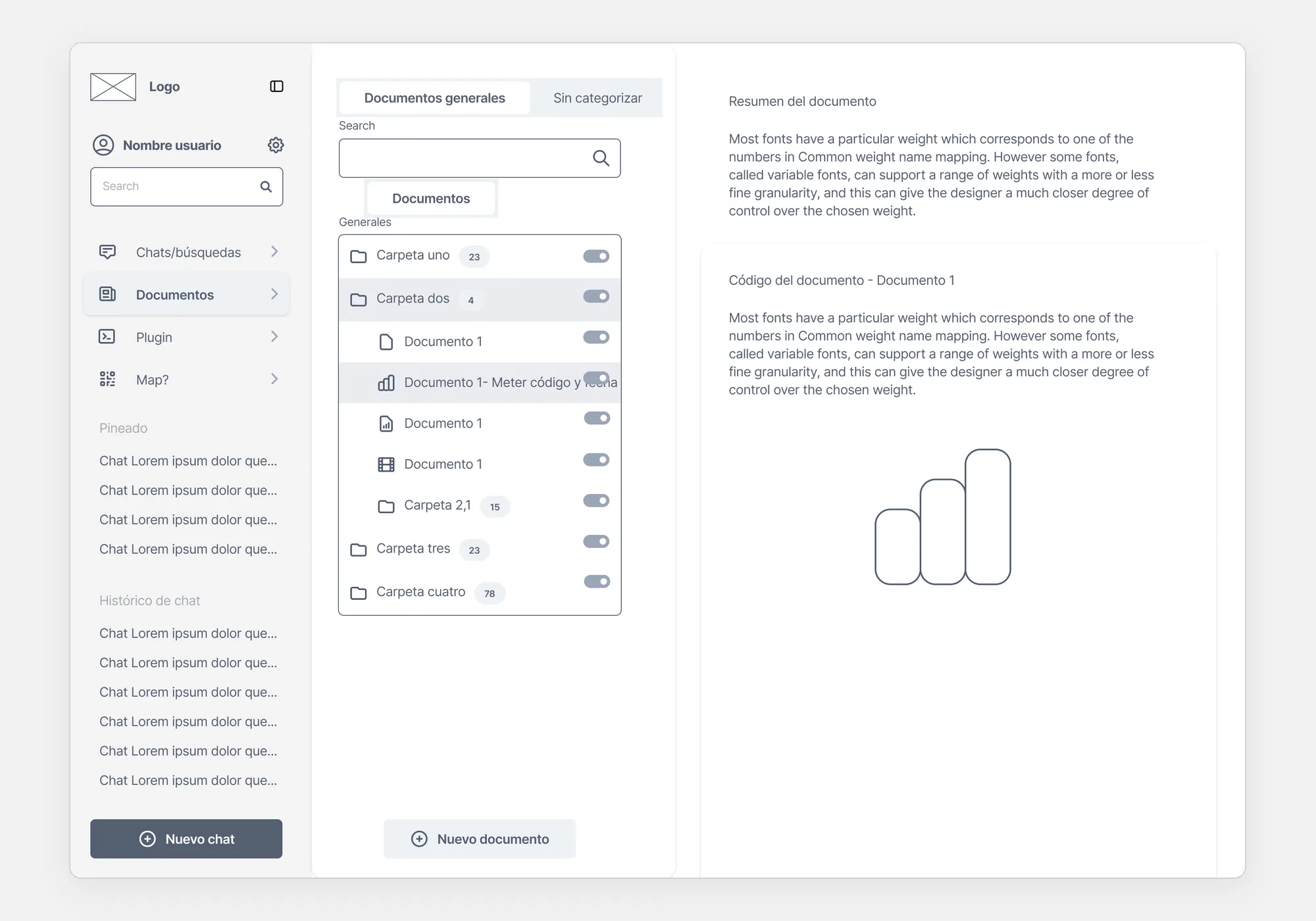
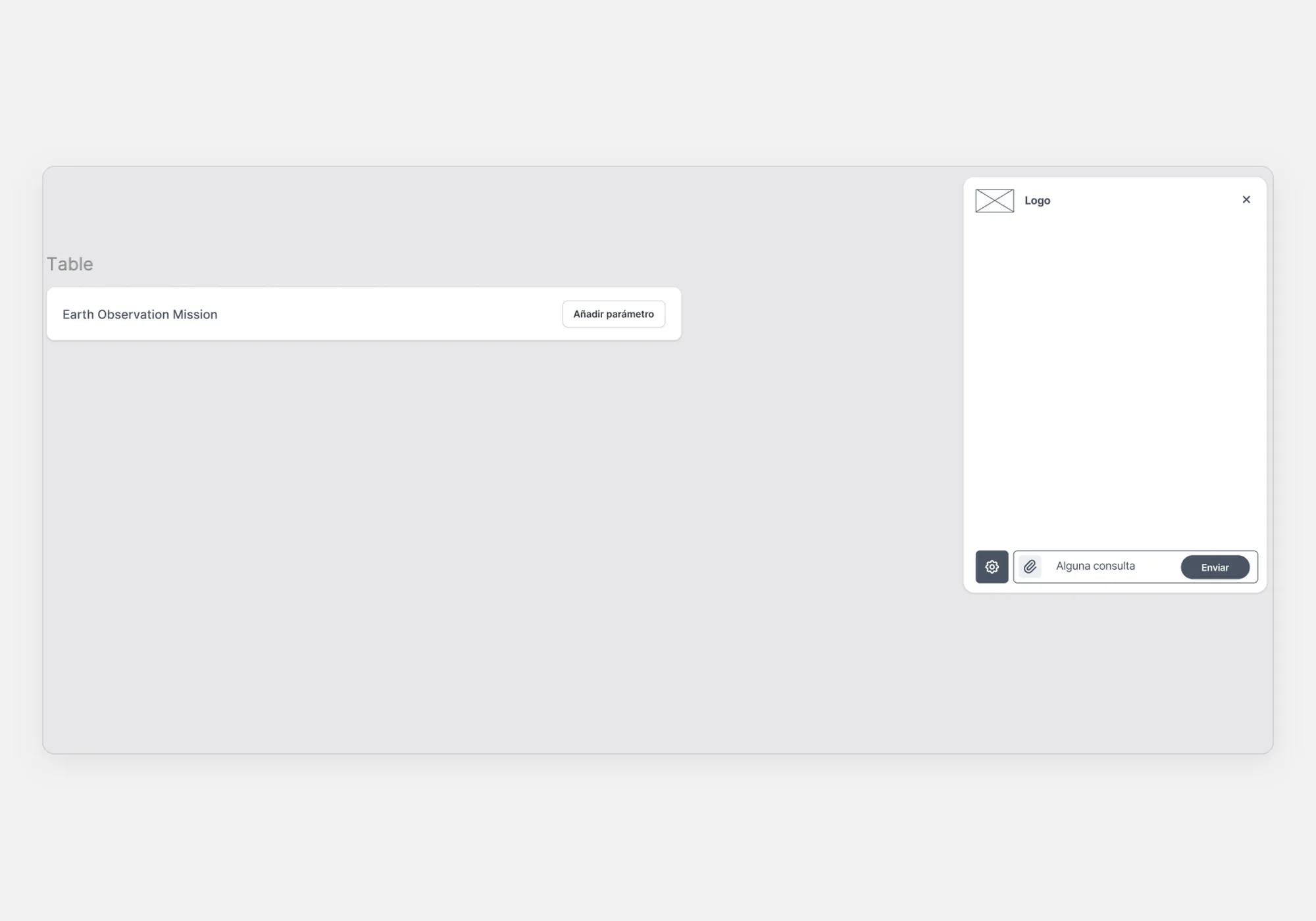
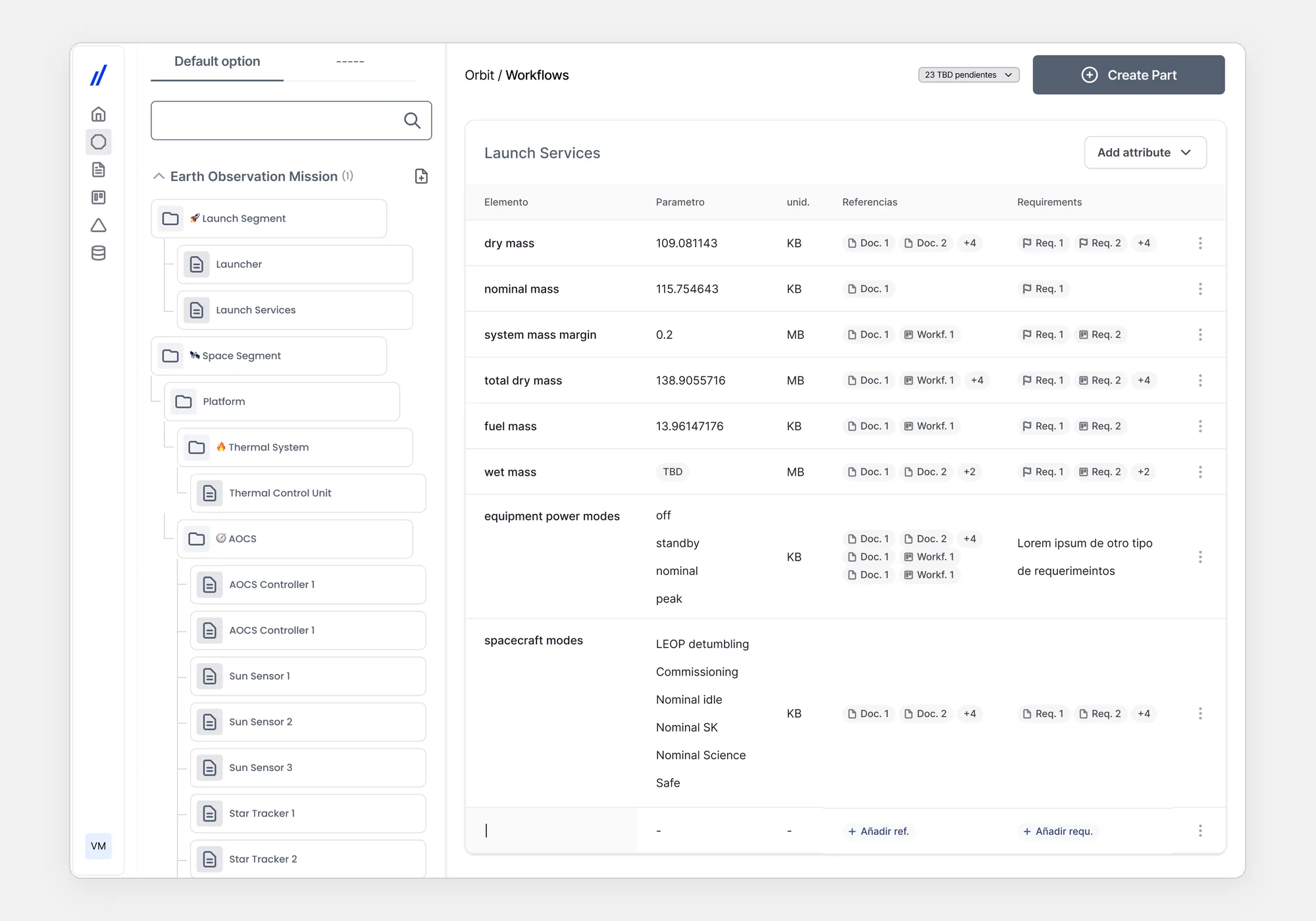
Llegamos a otra solución: primero el modelo del sistema, y la IA trabajando sobre él. Diseñé cómo funcionaría el agente dentro del producto y cómo se vería: en lugar de responder en una conversación, actúa sobre el modelo y su trabajo llega como un cambio pendiente de revisión, igual que el de cualquier ingeniero.
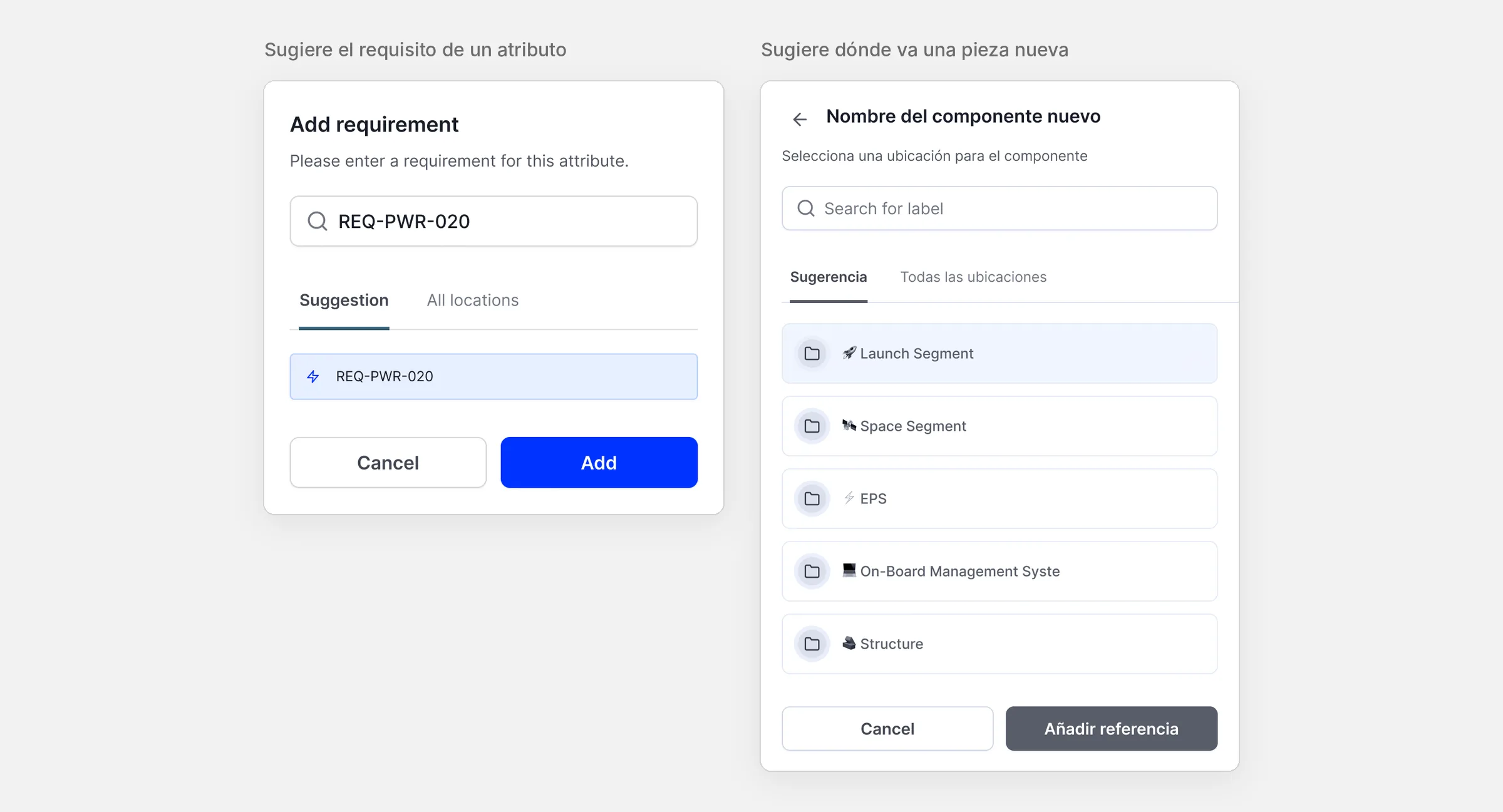
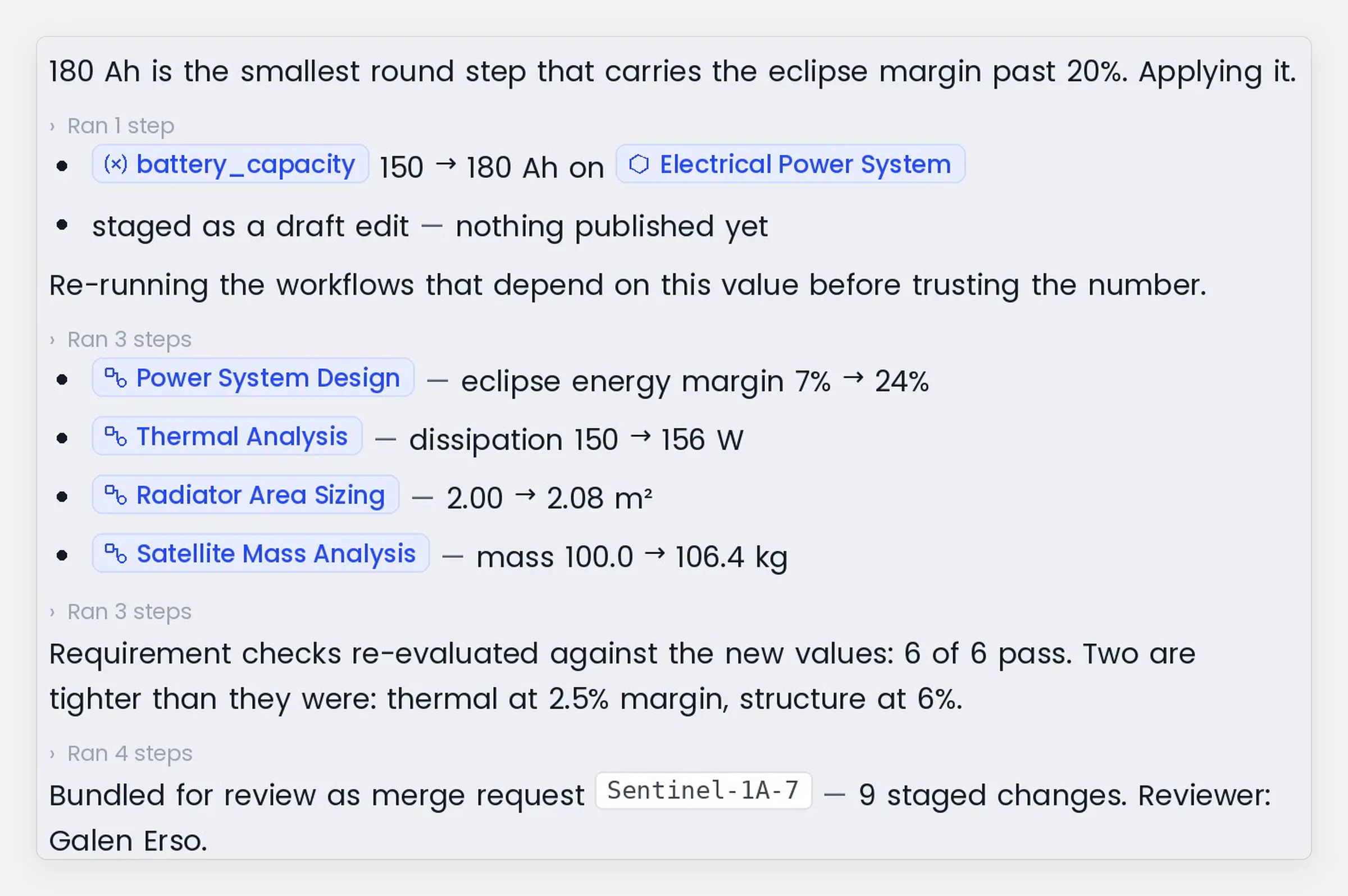
Con una sola instrucción, el agente cambia un valor, relanza los cálculos que dependen de él, recomprueba los requisitos y lo entrega todo como merge request. Los agentes externos se conectan por MCP con las mismas reglas. Todo se apoya en la misma decisión: poner el modelo en el centro.
Esconder el estándar sin esconder los datos
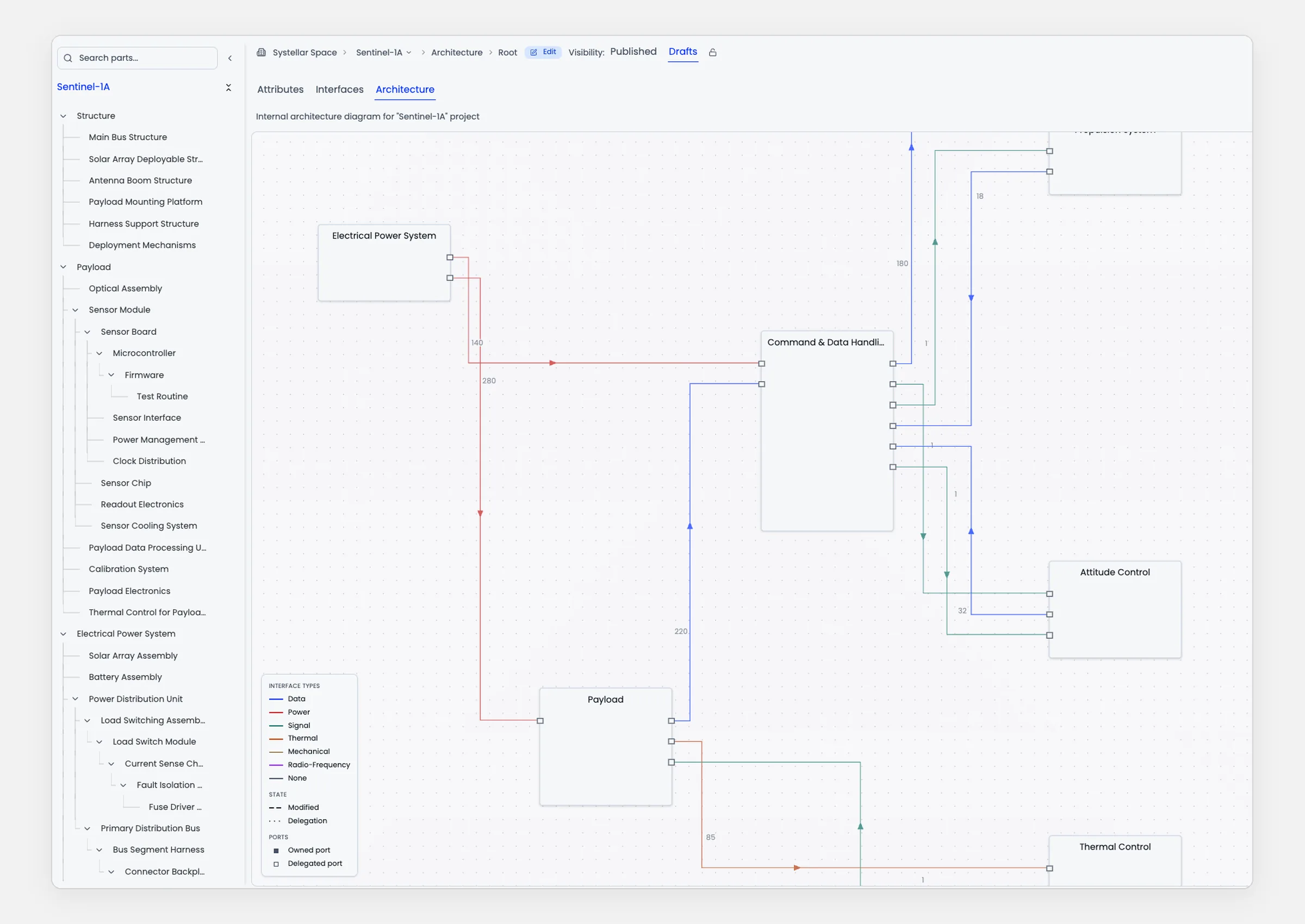
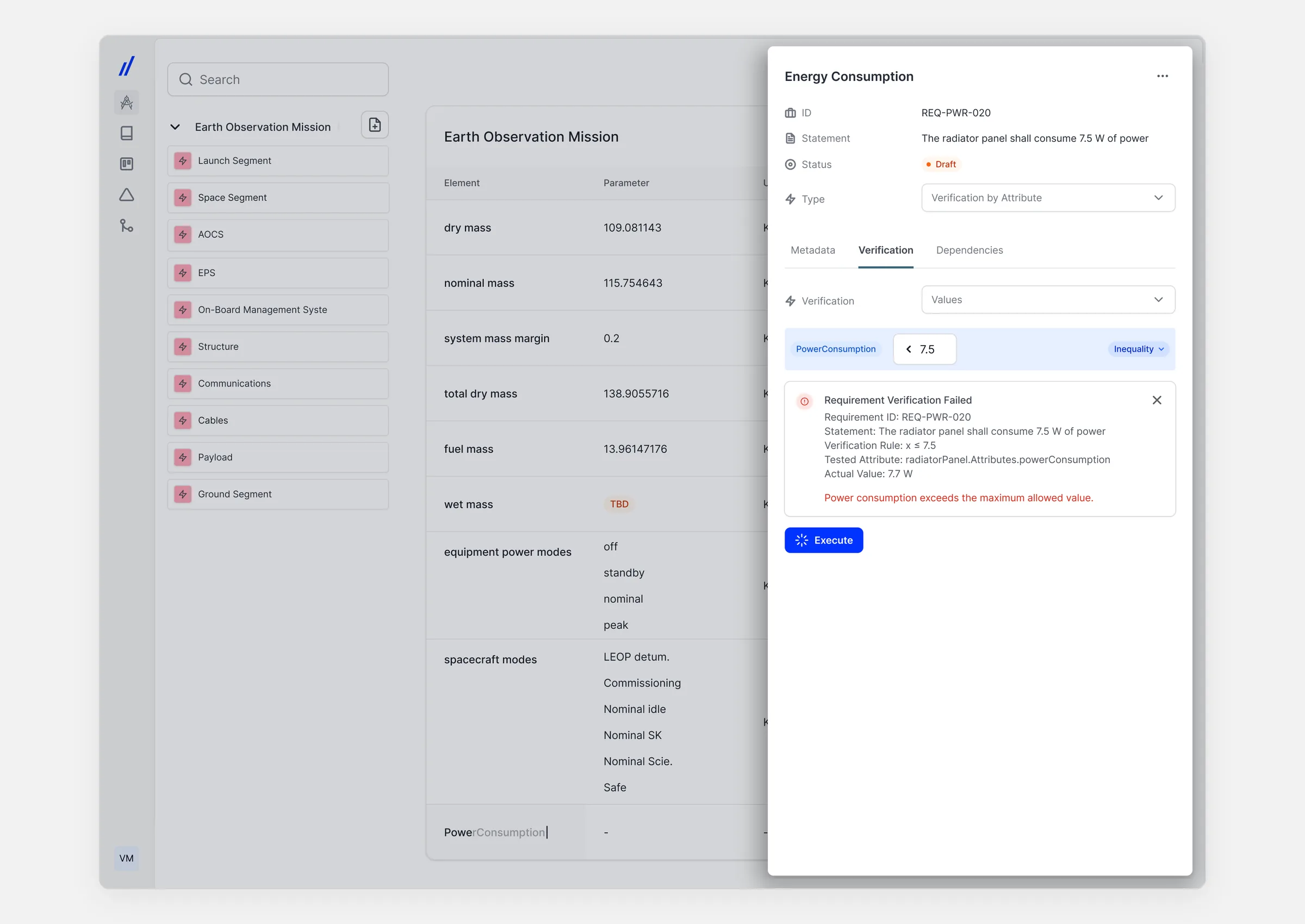
Lo obvio era exponer SysML v2 tal cual: es el estándar y el argumento técnico del producto. Pero eso nos convertía en una herramienta más para especialistas. Tradujimos el estándar a tres piezas que cualquier ingeniero reconoce: nodos (componentes con masa, consumo y volumen), puertos (lo que entra y sale) y requisitos (reglas que se comprueban solas). El modelo formal sigue debajo, completo. Si alguien cambia un componente o un valor, no recibe un error de sintaxis: cada requisito afectado se marca al momento, sin releer documentos ni comprobar a mano.
Revisar cambios como en software, pero con física
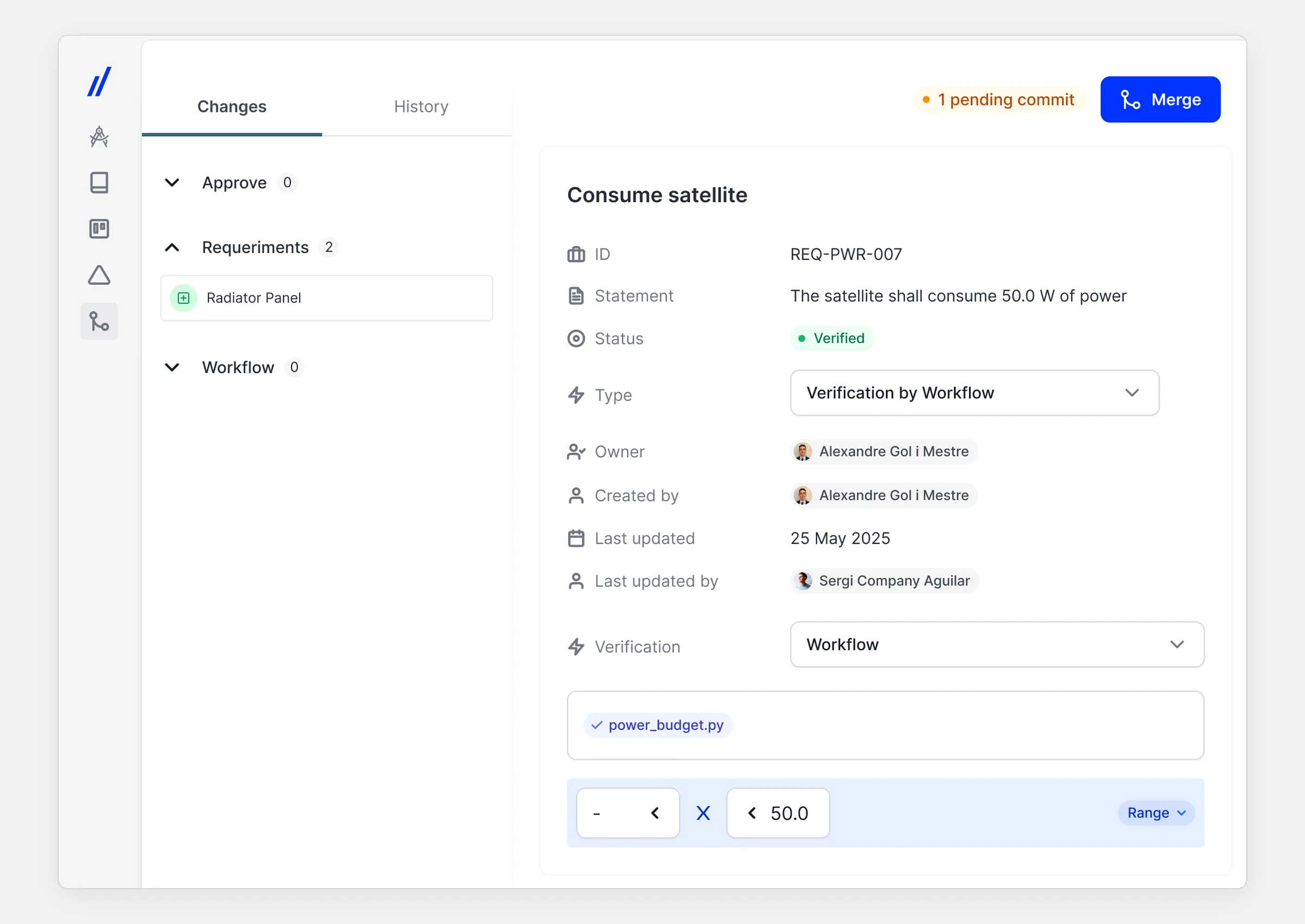
Un diff de software compara líneas. En un satélite, más batería puede romper el límite de masa del lanzador. Diseñamos la revisión como un merge request de ingeniería: antes de consolidar un cambio se ve el antes y el después de cada valor y qué requisitos y márgenes quedan comprometidos. Cambiar es fácil; aplicar sin ver el impacto, imposible.
Lo que no construí
En un 0 → 1 de 10 semanas, decidir qué no hacer pesa tanto como lo que se hace.
No diseñé para todos a la vez. Al pasar del chat al modelo, el usuario principal pasó a ser el ingeniero. El comercial técnico se quedó fuera de esta primera versión: lo que necesitaba era consultar información, algo más parecido a un buscador sobre la documentación que a una zona de trabajo.
No hice un lienzo de dibujo libre al estilo Miro: cajas y flechas sueltas habrían roto el modelo, así que cada línea es una conexión física real y lo imposible no se puede trazar. No di opciones de color ni de estilo: el color solo indica estado, nunca es decoración. No dejé que nada, ni personas ni agentes, cambiara márgenes de seguridad sin aprobación explícita. Y no rediseñé lo que el estándar ya resolvía bien: el modelo formal se quedó intacto debajo de la interfaz.
Proceso
Primero la arquitectura, después lo visual. Los wireframes sirvieron para decidir qué era el producto antes de decidir cómo se veía, y fueron los que hicieron evidente que el chat no era el centro.
- Entender el dominio con los founders
- Wireframes para definir la arquitectura del producto
- Cambio de rumbo: del chat al modelo del sistema
- Diseño visual sobre la arquitectura ya validada
- Librería de componentes
Una librería de componentes para un equipo pequeño
Con un solo diseñador y un equipo de desarrollo pequeño, la librería no era un lujo: era la única forma de mantener la consistencia sin revisar cada pantalla. No necesitaba la profundidad de un sistema de diseño multicliente como Ethos, pero sí la misma lógica. Partí de una base existente y la adapté por completo a Systellar: los componentes representan objetos de ingeniería (nodos del modelo, bloques de requisitos, estados de verificación), no piezas genéricas de SaaS.
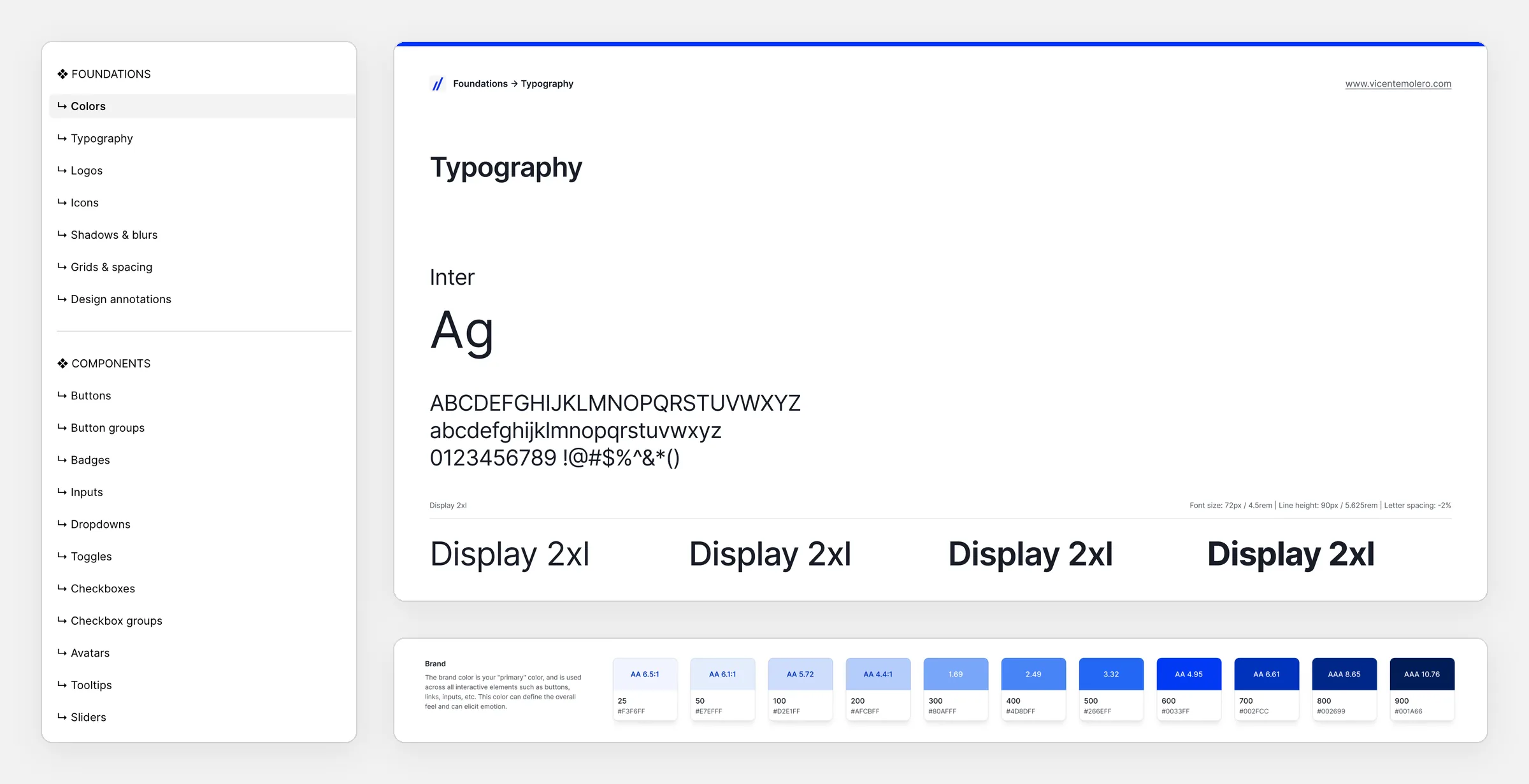
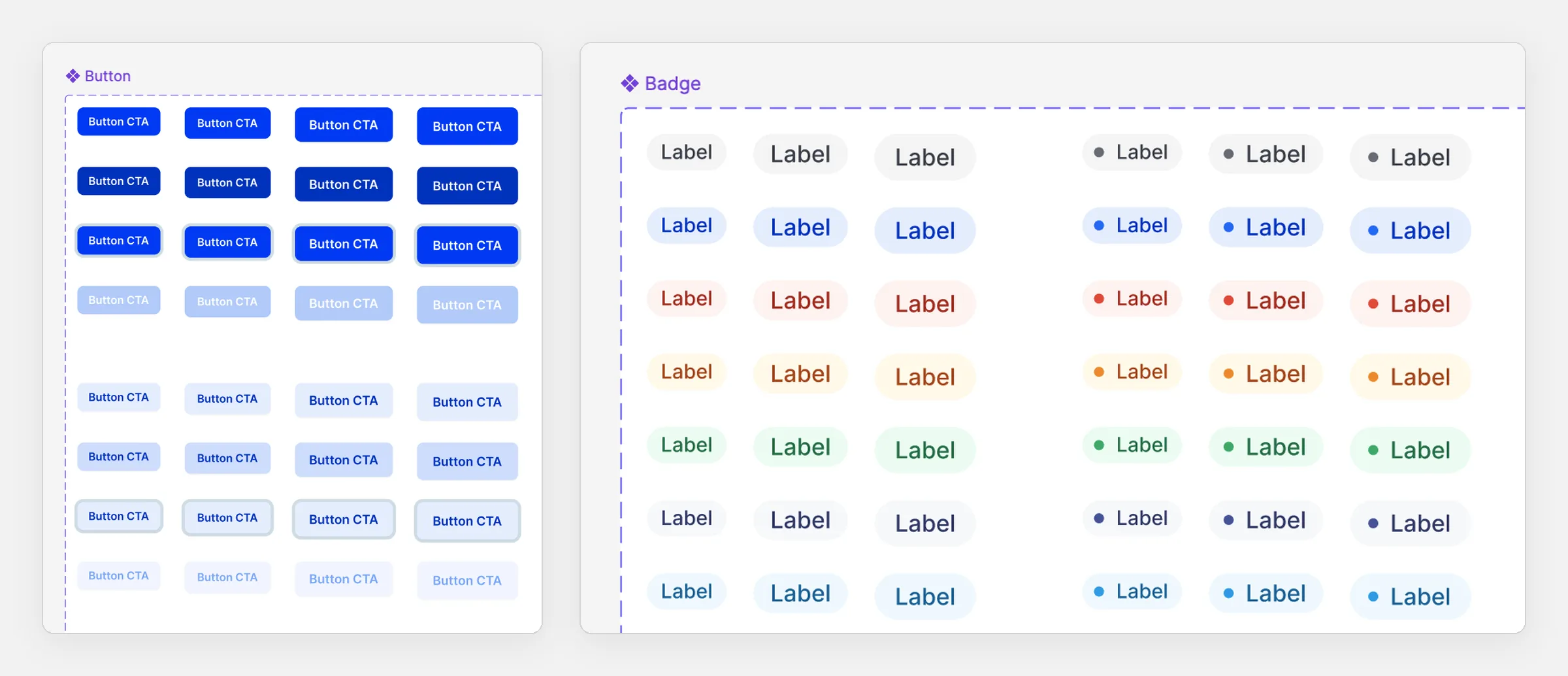
- Tokens de estado: el color solo indica estado, nunca es decoración.
- Nodos componibles: un nodo simple puede convertirse en contenedor de subsistemas sin perder proporciones ni puertos.
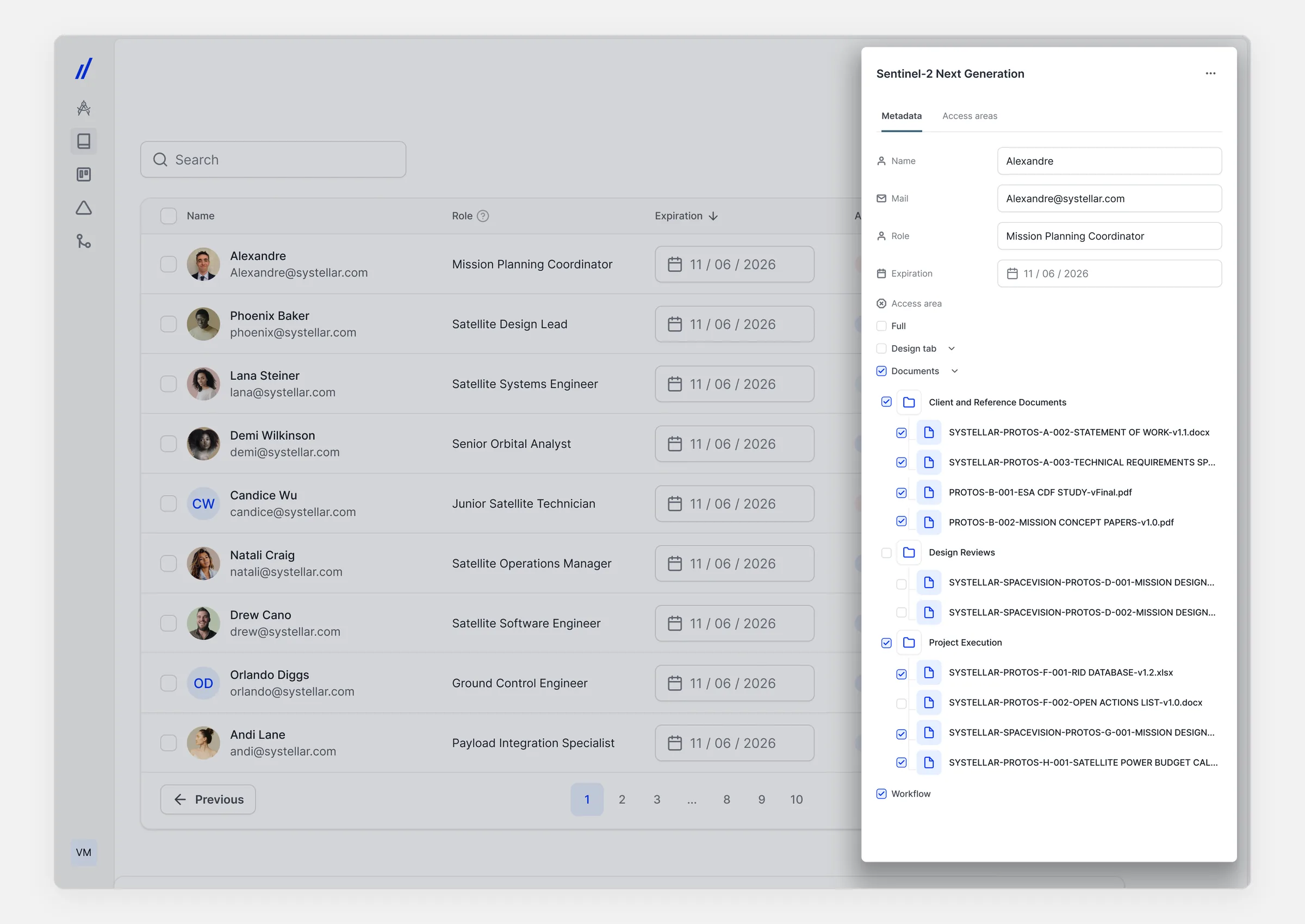
- Un único inspector lateral: la misma estructura sirve para editar un requisito, un documento o el acceso de una persona.
Aprendizajes
- La primera decisión de diseño fue cuestionar la solución. Un chat era la respuesta obvia para un producto con IA; entender el trabajo real fue lo que mostró que el valor estaba en el modelo, no en la conversación.
- Con usuarios expertos, la complejidad no se esconde: se ordena. Ocultar la sintaxis funcionó porque nunca ocultamos los datos.
- La confianza en un agente viene del proceso, no de la conversación. Darle las mismas reglas que a una persona (permisos, revisión, trazabilidad) resolvió más dudas que cualquier explicación en pantalla.
Qué haría ahora
Systellar ya ha construido parte de lo que venía después: agentes más autónomos y trabajo en paralelo con ingenieros. Si volviera hoy, me centraría en tres cosas:
- Medir el ahorro real. La web promete recuperar tiempo de ingeniería. Lo validaría con equipos como Tumbleweed, midiendo cuánto trabajo de reconciliación manual desaparece.
- Revisar a escala de agente. Cuando los agentes generan muchos cambios a la vez, revisar cambio a cambio no escala. Agruparía la revisión por intención: qué querías conseguir y qué se ha tocado para ello.
- Salir del espacio. La ambición de Systellar es cualquier hardware complejo, no solo satélites. Comprobaría qué parte del modelo mental de nodos, puertos y requisitos funciona en otros dominios y qué hay que adaptar.
Cierre
En este proyecto, lo más valioso no fue una pantalla, sino cambiar la solución de partida. La idea era un chat; el producto acabó siendo un modelo vivo del satélite con agentes trabajando dentro, y un año después un equipo real trabaja su nave en él.
En deep-tech, el diseño es lo que decide si la tecnología llega a usarse.
«Vicente cogió toda la complejidad de nuestro planteamiento y la aterrizó en algo productizable. Muy buen trabajo.»
In English
synapse™, a satellite engineering platform · Systellar
0 → 1 in 10 weeks · A year later, a real team is building its spacecraft in synapse™
Overview
Systellar · Deep-tech B2B
From hypothesis to aerospace platform
When the starting solution isn’t the one you need
Systellar, a deep-tech startup in Barcelona, wanted to build synapse™: a platform for designing satellites. The founders came in with a clear idea: an AI chat as the front door to the product. Session by session, learning the domain with them and with feedback from external engineers, we arrived at a different solution: a living model of the satellite where engineers do MBSE without realising it, and where AI agents work under the same rules as a person.
- Role
- Senior Product Designer · freelance · sole designer
- Client
- Systellar Space
- Dates
- Summer 2025 · 10 weeks
- Team
- 2 co-founders: CEO (MBSE specialist) and CTO (satellite operations) · small development team
- Scope
- Architecture, Requirements, Verification, Workflows, Version control and the AI agent experience
- Context
- Deep-tech startup in Barcelona, now accelerated by Techstars. When I joined there was no product, just a technical foundation and an idea for a solution: an AI chat.
In 30 seconds
In 30 seconds
- Problem
- In a satellite, a change to one component affects mass, power and thermal. But every piece of data lives in a different spreadsheet, script or PDF, and mismatches are found late, during integration or testing.
- Solution
- The initial idea was an AI chat. Once we understood how engineers work, we replaced it with a platform where the whole satellite is a single living model. Engineers work with components and physical connections, not syntax. Every change shows its impact before it’s applied, and AI agents go through the same review as a person.
- Impact
- From whiteboard to product in 10 weeks. A year later, Tumbleweed is building its Oasis spacecraft in synapse™, and its CTO says it’s easier to understand than typical engineering software.
Impact
- 10 weeks — From no product to a platform we could demo to clients and investors, with five modules designed.
- 1 change of direction — From an AI chat at the centre of the product to a living model of the system with AI working inside it.
What happened next
My engagement ended with those 10 weeks, with every deliverable closed. What came after is the product’s journey, not my result, but it confirms the direction:
- Systellar joins Techstars London.
- Finalist at the EU Startup Summit, one of 15 selected from more than 1,600 applications.
- Tumbleweed chooses synapse™ and is building its Oasis spacecraft in it. Its CTO says it’s easier to understand than most engineering software.
The company milestones (Techstars, EU Startup Summit) are context. The impact attributable to design is the time to product and adoption by a real engineering team.
The problem
Satellites don’t get complicated for lack of calculation, but because disciplines fall out of sync. The mass budget lives in a spreadsheet, requirements in a PDF nobody reopens after sign-off, and interfaces in slide decks. When a value changes, nothing tells you what depends on it.
The industry has an answer: MBSE with SysML v2, a machine-readable model of the system. But traditional tools demand weeks of training before you model your first subsystem, so small, fast teams don’t adopt it. The problem wasn’t technical. It was adoption.
Discovery
I didn’t come from aerospace, and the starting point had already been decided: an AI chat. Before designing it, I needed to understand what these engineers do every day and why their current tools (CATIA, Cameo, Excel) didn’t solve coordination. The founders had built system models at Airbus and ESA and operated 8 satellites, so they were my first source of domain knowledge.
- Sessions every 2–3 weeks with both founders: first we reviewed progress and conclusions, then we sketched together how they saw each part of the satellite.
- Feedback from external engineers, which the founders gathered and brought to each review.
- Between sessions, work with the real materials they shared with me: mass sheets, interfaces and requirements matrices.
We started from four proto-personas defined with the founders: a technical sales rep, a junior systems engineer, a lead integration engineer and a compliance lead. They were hypotheses, not research, but their frustrations matched: scattered, outdated information and no way of knowing which version is right. And there was a clear pattern with AI: they would use it if it saved them work, but only if it respected their standards and its work could be reviewed.
- “If I can’t find the right information quickly, I lose a business opportunity.”
- “If I had clear examples of previous documents, I’d learn much faster.”
- “I don’t have time to check every detail; I need the documentation to be clear from the start.”
- “Without clear, precise documentation, the project doesn’t pass review.”
Initial proto-personas. Starting hypotheses, not research findings.
- The key moment was trying to map how the chat would be used in a real workflow. The chat answered questions, but the work still lived in spreadsheets and documents. The more we looked at how an engineer works, the less sense it made.
- Engineers think in components and cables, not in the standard’s blocks and relationships. SysML v2 syntax was a barrier, not a help.
- What they needed first wasn’t to draw the system, but to know what breaks when something changes.
- An AI agent only earns trust if its work can be reviewed like a colleague’s.
Decisions
Three moments where the right decision wasn’t the obvious one.
From chat to model: questioning the starting solution
The founders came in with an AI chat as the heart of the product. It made sense in a demo and it’s what the market expects to see. I didn’t design chat screens: I started with wireframes to understand the product’s architecture, always thinking about how an engineer works. And that’s where the chat fell outside the workflow: it answered questions while the work stayed in spreadsheets and documents.
The shift didn’t happen overnight. The chat lost weight session by session, until a meeting with the founders where it became clear to everyone that it wasn’t the centre of the product. There was no argument to win: putting the engineer’s way of working in front of the idea was enough.
We arrived at a different solution: the system model first, with AI working on top of it. I designed how the agent would work inside the product and how it would look: instead of answering in a conversation, it acts on the model and its work arrives as a change pending review, just like any engineer’s.
With a single instruction, the agent changes a value, re-runs the calculations that depend on it, re-checks the requirements and hands it all over as a merge request. External agents connect through MCP under the same rules. It all rests on the same decision: putting the model at the centre.
Hiding the standard without hiding the data
The obvious move was to expose SysML v2 as is: it’s the standard and the product’s technical argument. But that would have made us one more tool for specialists. We translated the standard into three pieces any engineer recognises: nodes (components with mass, power draw and volume), ports (what goes in and out) and requirements (rules that check themselves). The formal model is still underneath, complete. If someone changes a component or a value, they don’t get a syntax error: every affected requirement is flagged instantly, with no rereading documents or checking by hand.
Reviewing changes like software, but with physics
A software diff compares lines. In a satellite, more battery can break the launcher’s mass limit. We designed review as an engineering merge request: before a change is committed you see the before and after of every value and which requirements and margins are put at risk. Changing is easy; applying without seeing the impact is impossible.
What I didn’t build
In a 10-week 0 → 1, deciding what not to do weighs as much as what you do.
I didn’t design for everyone at once. When we moved from the chat to the model, the engineer became the primary user. The technical sales rep was left out of this first version: what they needed was to look up information, closer to a search engine over the documentation than to a workspace.
I didn’t build a Miro-style freeform canvas: loose boxes and arrows would have broken the model, so every line is a real physical connection and the impossible can’t be drawn. I didn’t offer colour or style options: colour only signals state, never decoration. I didn’t let anything, people or agents, change safety margins without explicit approval. And I didn’t redesign what the standard already solved well: the formal model stayed intact beneath the interface.
Process
Architecture first, visuals second. The wireframes were for deciding what the product was before deciding how it looked, and they’re what made it obvious that the chat wasn’t the centre.
- Understand the domain with the founders
- Wireframes to define the product architecture
- Change of direction: from chat to system model
- Visual design on top of the validated architecture
- Component library
A component library for a small team
With a single designer and a small development team, the library wasn’t a luxury: it was the only way to keep things consistent without reviewing every screen. It didn’t need the depth of a multi-client design system like Ethos, but it did need the same logic. I started from an existing base and adapted it entirely to Systellar: the components represent engineering objects (model nodes, requirement blocks, verification states), not generic SaaS pieces.
- State tokens: colour only signals state, never decoration.
- Composable nodes: a simple node can become a container for subsystems without losing its proportions or ports.
- A single side inspector: the same structure works for editing a requirement, a document or a person’s access.
Learnings
- The first design decision was to question the solution. A chat was the obvious answer for an AI product; understanding the real work is what showed the value was in the model, not the conversation.
- With expert users, you don’t hide complexity: you organise it. Hiding the syntax worked because we never hid the data.
- Trust in an agent comes from the process, not the conversation. Giving it the same rules as a person (permissions, review, traceability) settled more doubts than any on-screen explanation.
What I’d do now
Systellar has already built part of what came next: more autonomous agents and work in parallel with engineers. If I went back today, I’d focus on three things:
- Measure the real savings. The website promises to win back engineering time. I’d validate it with teams like Tumbleweed, measuring how much manual reconciliation work disappears.
- Review at agent scale. When agents generate many changes at once, reviewing change by change doesn’t scale. I’d group review by intent: what you were trying to achieve and what was touched to get there.
- Go beyond space. Systellar’s ambition is any complex hardware, not just satellites. I’d test which parts of the nodes, ports and requirements mental model work in other domains and what needs adapting.
Closing
In this project, the most valuable thing wasn’t a screen, but changing the starting solution. The idea was a chat; the product ended up as a living model of the satellite with agents working inside it, and a year later a real team is building its spacecraft in it.
In deep tech, design is what decides whether the technology gets used.
“Vicente took all the complexity of our approach and turned it into something productizable. Great work.”